Has anyone already used this roller that mounts on the hood of the BCS rotary tiller and lets you adjust the working depth?
It seems like it could be an alternative to the rotary harrow for surface work, while being lighter, more maneuverable, and cheaper.
It is indeed an alternative, but is it really worth it? What is the price of the rotary tiller plus the adjustment roller, compared with the harrow alone? When buying the BCS, the rotary tiller is an option. We never use it. The rotary tiller’s work will compact the beds enormously, at the risk of having to use the rotary plow more often for the foot passes. The rotary harrow is absolutely perfect for our type of market gardening; I’m not sure an alternative could replace it. But that’s just one opinion.
@Sylvain_Couderc, I completely understand the problem of soil compaction caused by using a rotavator. I saw a tutorial where they recommend reversing the outer blades on each side of the rotary tiller so that the soil is brought toward the center rather than into the wheel tracks, to overcome this issue.
Otherwise, at Ciampelli, the rotavator is €650 + the depth roller €408, for a total of €1,058. The rotary harrow is €2,415. For me, the advantage is that if you buy used, the 740s are almost all equipped with the rotavator, and the precision roller only costs €408, whereas the rotary harrow remains at €2,415. That’s why I started looking into it. What’s more, I still have quite a bit of land to bring into cultivation following grassland, and I think the rotavator can help me there after a long period of tarping.
Several videos from the USA and Italy do comparative tests, and the results that generally come up are:
Rotavator + roller:
Advantages: More maneuverable - lighter - finer soil working - better incorporation of plant debris - easier to move - the rotavator can be used to open up uncultivated areas.
Disadvantages: risk of plow pan if used poorly (working too deep or on waterlogged soil)
Rotary harrow: Advantages: firmer seedbed - less plow pan.
Disadvantages: coarser surface work - poorer handling of green waste and crop residues.
So I wanted to see if anyone had had the chance to test both implements and could share their feedback.
@Daniel_Domingo „I saw a tutorial where they recommend flipping the teeth of the outer blades on each side of the tiller so that the soil is brought back toward the center rather than into the footpaths to work around this problem.“ I’d love to see that tutorial! Do you have the link? 
This is the BCS tutorial on PDR assembly: https://www.youtube.com/watch?v=BFchB2gJIv8&t=473s
@Daniel_Domingo Thanks, I’ve been using the tiller with the PDR for a season now, but I didn’t know there was this step! I’ll look into doing it soon!
I’ve just installed the roller on the rotary tiller. Initially I hadn’t opted to buy the rotary tiller because in the soil-working model proposed by Sylvain, the rotary harrow is always used. However, I found myself in complicated situations with very compacted beds. The rotary tiller allowed me to save the day. On the other hand, with the slightest heavy rain afterwards, everything collapses and clumps back up. In the case of my silty soil, then, it isn’t the solution but a spare wheel.
On the other hand, I added the roller to prepare the beds superficially for sowing after working them with the harrow. Otherwise I’d end up with more compact clods the size of pebbles than fine soil, and the footpaths would fill back in once the bed was prepared with the rake. I’ll report back on how useful it is for direct sowing.
@Meryll I’m not sure I understood correctly. Are you saying that after passing the harrow, your soil wasn’t prepared well enough and you had to go over it again with the rotary tiller + PDR to get something finer?
@Julien_Favry_La_Ferm So, are you happy with using it?
@Daniel_Domingo in the case of my soil, the work of the rotary harrow isn’t enough to be able to do direct seeding cleanly (especially for radishes). I prefer to rework the bed with a rake. The purpose of the tiller is to refine the surface layer of the soil so there are fewer clods of earth.
I also use the rotary tiller for shallow cultivation to destroy the root system of a crop residue or if the bed has become overgrown with weeds (after having gone over it with the mulcher).
@Daniel_Domingo Well thanks, I didn’t understand why there were pieces of the milling cutter’s shaft included!
@Meryll Same 
@Daniel_Domingo yes, it’s not bad when the bed is a bit grassy and I want to dig in some organic matter. And it does a decent job of roughing things out when I open up a garden. I go over the whole surface, then I mark out my beds with the rotary plough and finish with the rotary harrow. When the soil is a bit too wet for the rotary harrow, I use it as well (the mud sticks to it less).
@Daniel_Domingo I just made the change. It no longer adds them in the footrests. Great!
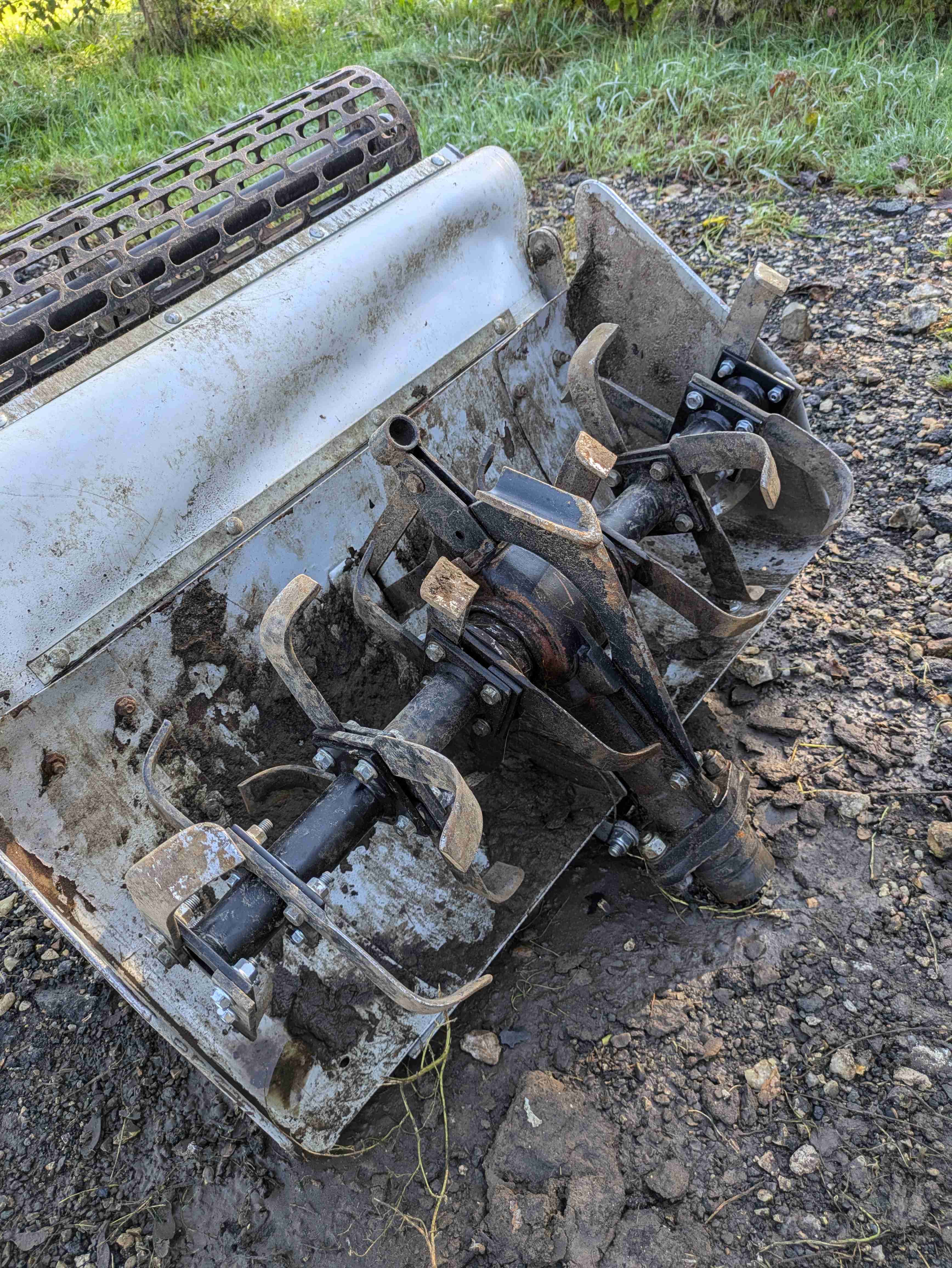
Hi!
We’ve got this pair of tools.
The only reason for getting them was the budget.
In terms of results for soil work:
It clearly does the job well! But I see several drawbacks after 3 years of use (context: sandy loam soil, 15% stones in its native state, less now, southwest):
- by design, a rotavator inevitably creates a hardpan
- because of how a rotavator works, you necessarily mix your horizons, even if you only work between 5 and 10 cm deep.
- after a stale seedbed, if you go over it quickly because it may have compacted, you’ll inevitably bring seeds back up (a bit a consequence of the previous point).
- I find that it doesn’t let you make the most of adding compost: indeed, you’ll bury a lot of it and therefore not benefit so much from the smothering effect it can have. I’m fairly sure that won’t happen with the harrow (observed with similar work using a tractor implement during my internships).
- despite the casing, you still throw a hell of a lot of soil onto your footboards
- in case of weed infestation such as couch grass, it breaks and buries the rhizomes. I’m not sure it’s as much with the harrow.
- clearly on the budget side there’s no contest, the rota+roller wins
- it’s very maneuverable
- maintenance is certainly simpler
That’s about it
Hi, I’ve been using it for a year. I don’t have a rotary harrow, so I can’t give a comparative opinion. I got it after a day of training on cover crops, where the technician recommended using it for burying cover crops (versus a rotary harrow). He claimed that under good soil-working conditions, at a depth of 10 cm you don’t create a plow pan.
It does indeed bring soil back into the footpaths. After it passes, the bed is more like 90 cm wide rather than 80 cm.
I have some overly clayey soils, and frankly it does the job. As for the plow pan, I hope that by combining cover crops + a broadfork + a shallow working depth, it avoids that problem.
@BIZIEN_Jerome did you make the modification-reversal of the rotavator’s tines?
No, I didn’t get the part you can see in the video.
Hi everyone,
I’ve read your entire conversation and it already answers a lot of the questions.
I still have one. What about burying the cork-based fertilizer? In my case, when there’s no need to redo my bed, the corks stay “on the surface” after the rotary harrow passes. So with sprinkler irrigation they break down a bit. But in the case of crops grown with drip irrigation, that’s less the case. I’m wondering whether the crop is therefore benefiting properly from the fertilization. One solution I’m considering is running a pass with the rotary tiller + PDR after the broadfork to bury my corks.
What do you think? Knowing that today the PDR is €485 + shipping.
Thanks